Top Free Business Directories 2026: Local SEO & Citation Strategy Guide
/* =========================================================
FREEDEETS.COM — LOCAL SEO ARTICLE STYLES
Clean, responsive, Blogger-friendly
========================================================= */
.fd-container {
font-family: ‘Segoe UI’, Roboto, -apple-system, BlinkMacSystemFont,
Helvetica, Arial, sans-serif;
line-height: 1.82;
color: #1e293b;
max-width: 860px;
margin: 0 auto;
font-size: 17px;
}
.fd-container p,
.fd-container ul,
.fd-container ol {
margin-bottom: 22px;
}
/* RESPONSIVE ARTICLE IMAGES */
.fd-container img {
display: block;
width: 100%;
max-width: 860px;
height: auto;
margin-left: auto;
margin-right: auto;
}
/* INTRO / CONTENT SEPARATOR */
.fd-divider {
border: 0;
border-top: 1px solid #cbd5e1;
margin: 38px 0;
}
/* MAIN SECTION HEADING */
.fd-heading {
margin-top: 42px;
margin-bottom: 24px;
padding: 16px 22px;
background: linear-gradient(135deg, #0f172a 0%, #1e293b 100%);
border-left: 6px solid #047857;
border-radius: 0 10px 10px 0;
box-shadow: 0 4px 14px rgba(0,0,0,0.12);
}
.fd-heading h2 {
font-size: 1.48em !important;
font-weight: 700 !important;
color: #a7f3d0 !important;
margin: 0 !important;
padding: 0 !important;
line-height: 1.35 !important;
border: none !important;
letter-spacing: -0.2px;
}
/* SUBHEADING */
.fd-h3 {
font-size: 1.22em;
font-weight: 700;
color: #0f172a;
margin-top: 30px;
margin-bottom: 12px;
line-height: 1.4;
display: flex;
align-items: center;
gap: 10px;
}
.fd-h3::before {
content: ”;
display: inline-block;
width: 7px;
min-width: 7px;
height: 18px;
background-color: #047857;
border-radius: 3px;
}
/* TRUST / INSIGHT BOX */
.fd-insight {
background: #ecfdf5;
border: 1px solid #a7f3d0;
border-left: 5px solid #047857;
padding: 21px;
border-radius: 8px;
margin: 28px 0;
box-shadow: 0 2px 8px rgba(4,120,87,0.07);
}
.fd-insight h3 {
color: #065f46;
font-size: 1.08em;
margin: 0 0 8px;
}
.fd-insight p {
color: #047857;
margin: 0;
}
/* TABLE OF CONTENTS */
.fd-toc {
background: #f8fafc;
border: 1px solid #e2e8f0;
border-left: 5px solid #047857;
padding: 20px 22px;
border-radius: 8px;
margin: 30px 0;
}
.fd-toc-title {
font-weight: 700;
color: #0f172a;
margin-bottom: 10px;
font-size: 1.08em;
}
.fd-toc ol {
margin: 0;
padding-left: 22px;
}
.fd-toc li {
margin-bottom: 7px;
}
/* TABLE */
.fd-table-wrapper {
overflow-x: auto;
margin: 30px 0;
border-radius: 8px;
box-shadow: 0 2px 10px rgba(0,0,0,0.05);
}
.fd-table {
width: 100%;
border-collapse: collapse;
text-align: left;
font-size: 0.94em;
min-width: 680px;
}
.fd-table th {
background: #0f172a;
color: #a7f3d0;
padding: 14px 16px;
font-weight: 600;
}
.fd-table td {
padding: 14px 16px;
border-bottom: 1px solid #e2e8f0;
color: #334155;
vertical-align: top;
}
.fd-table tr:nth-child(even) {
background: #f8fafc;
}
.fd-table tr:hover {
background: #ecfdf5;
}
/* CHECKLIST */
.fd-checklist {
background: #f8fafc;
border: 1px solid #e2e8f0;
border-radius: 8px;
padding: 18px 22px;
margin: 25px 0;
}
.fd-checklist li {
margin-bottom: 9px;
}
/* RELATED ARTICLES */
.fd-related {
background: #f8fafc;
border: 1px solid #e2e8f0;
border-left: 5px solid #0f172a;
border-radius: 8px;
margin: 32px 0;
padding: 22px;
}
.fd-related p {
color: #0f172a;
font-weight: 700;
margin: 0 0 10px;
}
.fd-related ul {
margin: 0;
padding-left: 20px;
}
.fd-related li {
margin-bottom: 8px;
}
.fd-related a {
color: #047857;
font-weight: 600;
text-decoration: none;
}
.fd-related a:hover {
text-decoration: underline;
}
/* MOBILE */
@media screen and (max-width: 600px) {
.fd-container {
font-size: 16px;
line-height: 1.75;
}
.fd-heading {
padding: 14px 16px;
}
.fd-heading h2 {
font-size: 1.28em !important;
}
.fd-table {
font-size: 0.9em;
}
}

For small and mid-sized businesses across the United States, appearing in
local search results is an important part of customer acquisition. Whether
the business is a medical practice, law firm, restaurant, home-service
provider, retailer, or professional service company, accurate business
information across trusted online platforms can make it easier for customers
to discover and evaluate the business.
Business directories are one part of this local search ecosystem. They can
help customers find a company, reinforce consistent business information,
generate referral traffic, and provide additional places where a brand can
establish its presence.
In this FreeDeets guide, we examine major free business-directory platforms,
explain how to prioritize them, show how to maintain consistent business
information, and provide a practical citation strategy for local businesses
in 2026.
Quick Takeaway
Start with the platforms that directly matter to your customers and
search ecosystem. Keep your business name, address or service area,
phone number, website, category, and hours accurate. Then expand into
reputable industry and local directories rather than submitting to
large numbers of low-quality sites.
1. How Business Directories Support Local SEO
A business directory is an online platform that publishes information about
companies, organizations, professionals, or local services. Examples include
search-platform business profiles, map listings, consumer review websites,
social business pages, and industry-specific directories.
Directory listings are useful because they create additional sources of
information about a business. When important details are accurate and
consistent, customers have fewer opportunities to encounter conflicting
information.
Google also expects businesses to represent themselves accurately and
consistently in the real world. Its Business Profile guidance specifically
emphasizes accurate business information, addresses or service areas, and
useful descriptions.
However, directory submissions should not be treated as a shortcut to
rankings. A strong local-search strategy combines an accurate business
profile, useful website content, customer reviews, relevant local signals,
strong user experience, and appropriate industry citations.
2. Top Free Business Directories for 2026
The best directory depends on the business type, location, customers, and
search ecosystem. Instead of chasing a specific number of listings, prioritize
platforms that are authoritative, relevant, actively maintained, and useful
to real customers.
| Platform | Best For | Primary Benefit | Priority |
|---|---|---|---|
| Google Business Profile | Most local businesses | Business presence across Google Search and Maps | Essential |
| Apple Business Connect | Local businesses and physical locations | Business information and place presence within Apple’s ecosystem | High |
| Bing Places for Business | Local and service businesses | Business information within Microsoft’s search ecosystem | High |
| Yelp for Business | Restaurants, home services, healthcare and consumer services | Consumer discovery, reviews and referral traffic | High |
| Facebook Business Page | B2C and community-focused businesses | Brand discovery, customer interaction and business information | High |
| LinkedIn Company Page | B2B, corporate and professional services | Company identity, professional credibility and discovery | High for B2B |
| BBB | Businesses where trust and reputation matter | Business reputation and consumer trust signals | Relevant |
| Yellow Pages | Local and trade services | Business discovery and additional citation presence | Relevant |
Important: Don’t Chase Directory Quantity
Ten relevant, accurate listings can be more useful than hundreds of
low-quality directory submissions. The goal is not to create the largest
possible citation footprint; the goal is to build a trustworthy,
consistent and useful business presence.
3. Priority Directory Profiles
The following platforms should generally receive attention before a business
spends time submitting to smaller directories.
Google Business Profile is a foundational profile for businesses that qualify
for a Google Business Profile. It allows eligible businesses to manage
information that can appear across Google Search and Maps.
- Use the real-world business name.
- Choose the most appropriate primary business category.
- Keep address or service-area information accurate.
- Maintain accurate opening hours and contact details.
- Add useful business descriptions, services and appropriate media.
- Monitor and respond appropriately to genuine customer reviews.
Google specifically advises businesses to represent themselves consistently
with their real-world identity and to provide accurate address or service-area
information.
Apple Business Connect is particularly useful for businesses that want their
location and business information represented within Apple’s ecosystem.
Restaurants, retailers, professional offices and other customer-facing
businesses should consider maintaining an accurate Apple business presence.
Bing Places is another important platform for maintaining business
information within Microsoft’s search ecosystem. Businesses should ensure
that the information submitted to Bing agrees with their official website
and other major listings.
Yelp can be particularly relevant for consumer-facing businesses where
customers use reviews and local business information to compare providers.
Restaurants, home services, healthcare providers, automotive businesses and
other local services should evaluate whether Yelp is relevant to their
audience.
NAP Consistency: What It Really Means
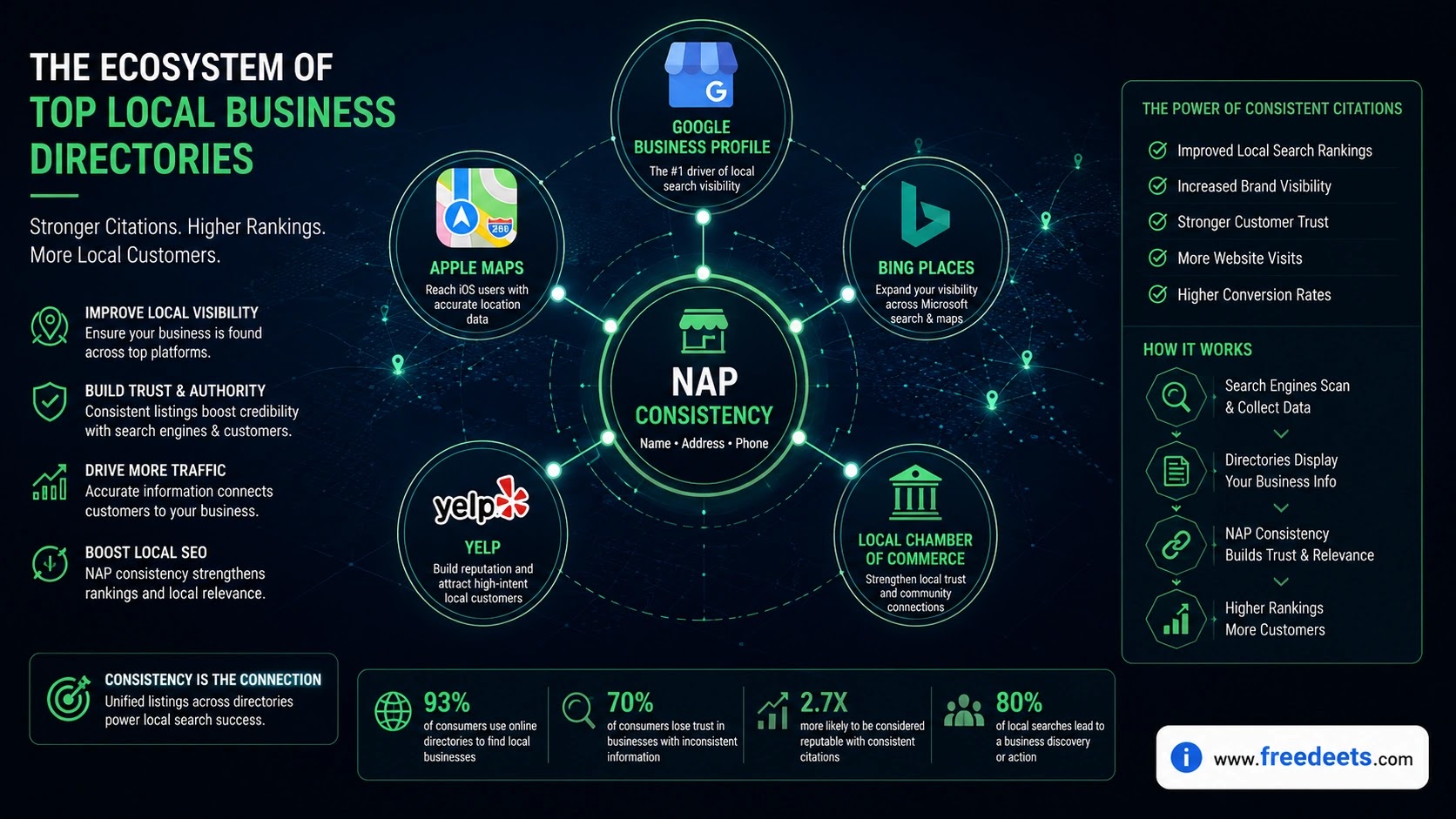
NAP stands for Name, Address and Phone Number. Your
important business information should be accurate and consistent across
major platforms. Do not create artificial variations simply to insert
additional keywords. Use the business information that accurately
represents the company.
4. Directory Optimization Strategy
Creating a listing is only the beginning. A complete profile should give
customers enough information to understand what the business does, where it
operates, and how they can contact it.
Write an original description that explains the company’s services,
customers, location and differentiators. Use natural language rather than
repeating the same keyword or city name excessively.
Google recommends that business descriptions focus on useful information
about the services, products, mission and history of the business rather than
irrelevant promotional material.
Maintain a master record containing your official business name, address,
phone number, website URL, categories, business hours and service areas.
Use this information as the reference point whenever you create or update a
directory listing.
- Business name matches the real-world business identity.
- Address is accurate wherever an address is appropriate.
- Phone number reaches the correct business location or contact point.
- Website URL points to the correct official website.
- Business hours are kept current.
- Primary category accurately describes the business.
- Service areas accurately represent where the business operates.
Reviews can influence how potential customers evaluate a local business.
Encourage genuine customers to share honest experiences through platforms
where the business has a legitimate profile. Respond professionally and do
not manufacture, buy or manipulate reviews.
Complete profiles are generally more useful to customers than empty profiles.
Where supported, add relevant services, products, photographs, business
attributes, booking information and other legitimate details.
5. Niche & Hyper-Local Directories
After the major platforms are complete, look for directories that are
specifically relevant to your industry or geographic market.
-
Local chambers of commerce:
Useful when the organization maintains a legitimate member directory or
business listing. -
Industry associations:
Look for reputable professional organizations serving your sector. -
Local community directories:
Consider established local organizations, business groups and regional
publications where appropriate. -
Industry marketplaces:
Use platforms that genuinely help customers find providers in your
particular industry.
Examples may include industry-specific platforms for home improvement,
healthcare, legal services, restaurants, hospitality, professional services
and other specialized sectors. Relevance should be the deciding factor—not
simply whether a directory allows a free submission.
6. Common Local Citation Mistakes to Avoid
Avoid creating multiple listings for the same business location unless the
platform’s rules specifically permit separate profiles. Duplicate records
can create confusion for customers and make profile management harder.
Do not use an address simply because it looks more attractive for local
search. Google has specific requirements for business locations and
service-area businesses. A service-area business that does not serve
customers at its address may need to hide its address rather than publishing
a residential location.
Google also states that a virtual office cannot be used as a Business Profile
location unless that office is staffed during the relevant business hours.
Do not add city names, services, keywords or promotional phrases to a
business name unless they are genuinely part of the real-world business
name. Google specifically advises businesses to use their real-world
business name.
Avoid mass-submission strategies focused on hundreds of weak or irrelevant
directories. A smaller collection of reputable, relevant listings is easier
to maintain and more useful to customers.
Business information changes over time. Review important profiles whenever
the company changes its address, telephone number, website, opening hours,
services or operating area.
7. Tracking Citation Performance
Directory optimization should be measurable. Use analytics to determine
whether individual listings generate website visits, enquiries, calls or
other meaningful actions.
Where a directory allows campaign parameters on website URLs, UTM parameters
can help distinguish referral traffic from different sources.
Simple Measurement Framework
Track referral visits,
contact-form submissions,
phone enquiries,
booking actions, and other business outcomes—not merely
the number of directory listings created.
8. Frequently Asked Questions
Free listings can provide a strong foundation, particularly on major
platforms that are relevant to your customers. However, directories are only
one component of a broader local SEO strategy. Website quality, relevance,
customer experience, reviews and other local signals also matter.
There is no universal number that guarantees better rankings. Start with the
major platforms relevant to your business, then add reputable industry and
local directories. Prioritize quality, relevance and accuracy over quantity.
A qualifying service-area business that does not serve customers at its
business address can hide the address on its Google Business Profile and
specify the areas it serves. Google allows service areas to be defined using
cities, postal codes or other geographic areas.
Not necessarily. Yelp should be prioritized when it is relevant to your
industry and customer base. A restaurant or consumer-facing local service
business may gain more practical value from Yelp than a business whose
customers rarely use the platform.
No. Directory citations do not guarantee a position in Google’s organic
results or local results. Treat listings as one part of a broader search
strategy rather than a ranking shortcut.
Maintain one authoritative business-information document containing the
official name, address, phone number, website, hours, categories and service
areas. Review important listings periodically and update them whenever
business information changes.
Final Takeaway: Build a Citation Strategy, Not a Directory List
The strongest local SEO strategy is not about collecting the largest possible
number of directory links. It is about creating an accurate, trustworthy and
useful digital footprint across platforms that customers and search systems
actually use.
Start with your primary business profile, keep core information consistent,
build relevant industry and local citations, maintain genuine customer
reviews, and measure which platforms produce meaningful business results.
Most importantly, treat directory listings as an extension of your overall
brand presence. When every major profile communicates the same accurate
business information and your website provides genuinely useful content,
customers have a clearer path from local discovery to conversion.
Editorial Note
Information about directory features, eligibility requirements and
platform policies can change. Before creating or modifying a business
profile, review the current requirements of the individual platform and
use information that accurately represents the real business.