Commercial Property Insurance Guide (2026): Building Coverage & Loss Defense
Operating a business in the United States requires substantial capital investment in physical infrastructure. Whether you manage an industrial distribution warehouse, own a retail shopping center, or lease a healthcare suite, physical assets serve as the foundation of your daily revenue. Securing comprehensive commercial property insurance is essential to protect structural foundations, expensive machinery, and inventory against unexpected perils like fires, storms, and water pipe failures.
Unexpected physical disasters can immediately interrupt operations. According to small business disaster recovery data from the U.S. Small Business Administration (SBA), more than 25 percent of commercial businesses fail to reopen following a major catastrophic property loss. Maintaining a tailored property policy ensures your business can rebuild structural assets and replace damaged equipment without facing financial insolvency.
Strategic Risk Note for Commercial Tenants
If you lease rather than own your commercial facility, your landlord’s insurance covers only the outer structural shell. You remain financially responsible for your interior improvements, trade fixtures, inventory, and office workstations.
1. Core Assets Covered by Commercial Property Insurance
Standard commercial property insurance forms written across the United States categorize insurable business assets into three distinct areas:
- Building Real Property: Covers the core physical building, permanent fixtures, attached outdoor signage, HVAC climate control systems, and permanent interior installations.
- Business Personal Property (BPP): Protects movable assets located inside or within 100 feet of your commercial premises, including manufacturing machinery, raw inventory, computers, and office furniture.
- Personal Property of Others: Reimburses property owned by customers or suppliers while it is in your care, custody, or control (such as equipment left on-site for maintenance).
2. Valuation Methods: Replacement Cost vs. Actual Cash Value
The valuation method specified in your policy determines how loss settlements are calculated after a disaster. Selecting the wrong method can leave a business with substantial out-of-pocket expenses during rebuilding.
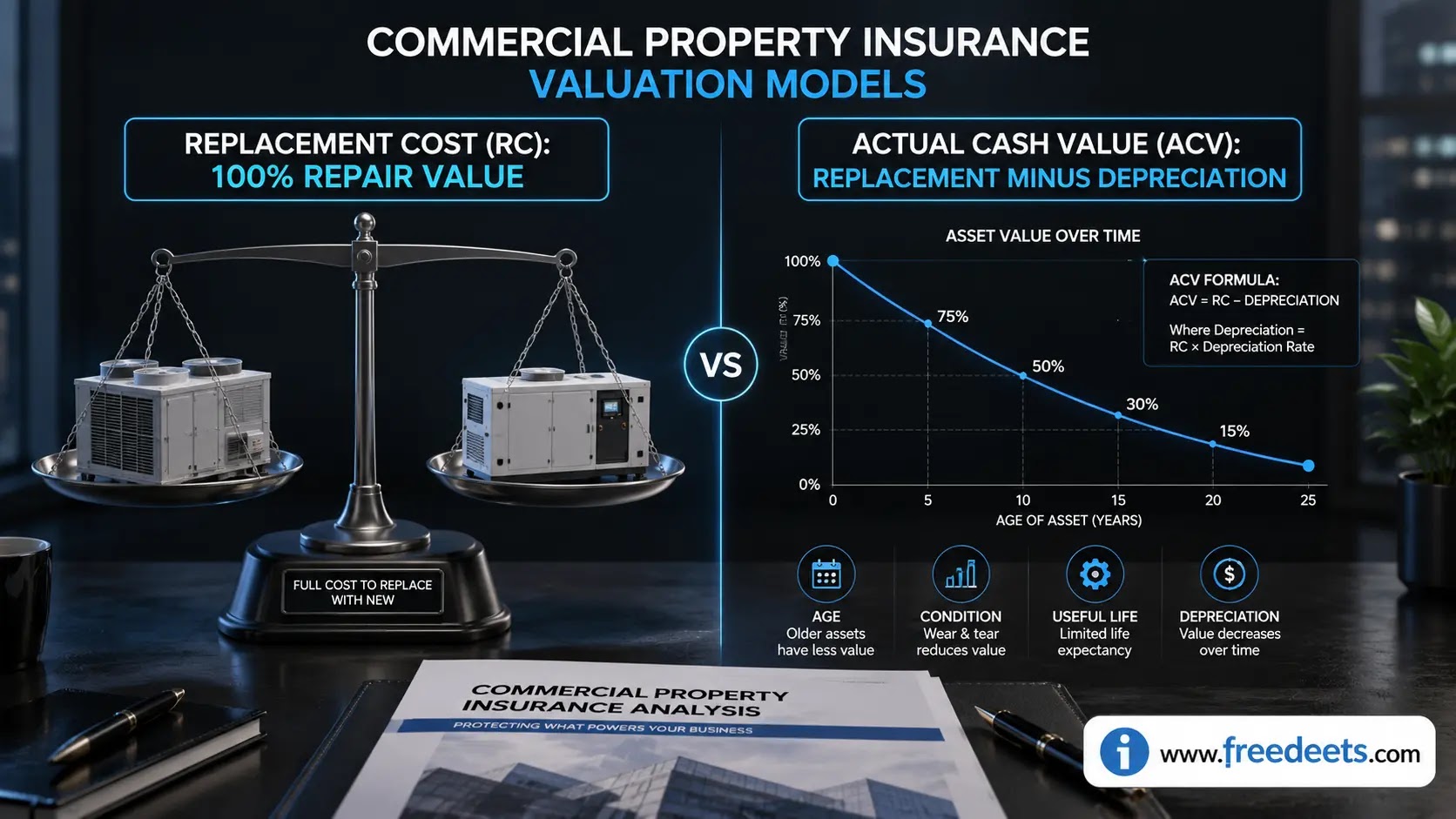
Replacement Cost (RC)
Replacement Cost coverage pays to repair or rebuild damaged property with new materials of like kind and quality, without deducting for physical wear or depreciation. While RC coverage carries slightly higher annual premiums, it provides complete capital recovery following a loss.
Actual Cash Value (ACV)
Actual Cash Value calculates claim payouts by starting with the cost of replacement and subtracting accumulated physical depreciation based on age and use. If a 10-year-old roof is damaged, an ACV settlement pays only for its remaining depreciated life, requiring the business to cover the rest of the cost.
| Valuation Feature | Replacement Cost (RC) | Actual Cash Value (ACV) |
|---|---|---|
| Depreciation Deduction | No deduction for age or use | Deducts depreciation based on asset age |
| Out-of-Pocket Expense | Low (Restricted to deductible) | High (Business funds depreciation gap) |
| Annual Premium Rate | Standard to Moderate | Lower Initial Cost |
| Recommended Use | Active facilities needing rapid restarts | Older structures or secondary storage |
3. Business Interruption: Protecting Ongoing Operating Revenue
Rebuilding physical structures represents only part of total disaster recovery. When a severe incident forces temporary closure, fixed operating expenses continue while sales revenue drops to zero.
Business Interruption Insurance (also known as Business Income Coverage) serves as a critical addition to commercial property insurance policies. It reimburses lost net profits and ongoing operational expenses while physical restoration takes place:
- Net Revenue Replacement: Reimburses expected net profit based on past financial statements.
- Ongoing Operational Expenses: Pays continuing bills including commercial mortgage payments, lease obligations, property taxes, and loan interest.
- Key Employee Payroll: Allows you to retain essential managers and technical staff so operations can resume smoothly.
- Extra Expense Provisions: Covers non-standard expenses incurred to reduce business downtime, such as leasing temporary office space or renting industrial power generators.
4. Navigating Coinsurance Penalties and Inflation Guards
Insurers often require policyholders to insure their property to a specific percentage of its total replacement value (typically 80%, 90%, or 100%) through a coinsurance clause. If a commercial property owner underinsures a facility to save on premium expenses, the insurer will apply a proportional penalty formula to partial claims:
(Carried Limit / Required Limit) × Loss Amount = Payout Settlement
To guard against unintentional coinsurance penalties driven by inflation and rising local construction prices, businesses should add an Inflation Guard Endorsement. This rider automatically adjusts coverage limits upward on a scheduled basis to match regional cost indices.
Frequently Asked Questions About Commercial Property Insurance
How much does commercial property insurance cost per year?
Small to mid-sized businesses typically pay between $1,000 and $5,000 annually for standard coverage. Exact pricing varies based on building construction materials, square footage, fire suppression hardware, and local natural hazard exposure.
Does standard commercial property insurance cover flood or earthquake damage?
No. Standard commercial property insurance forms explicitly exclude rising surface floodwaters and earth movement. Businesses in designated flood zones must purchase standalone commercial flood coverage through the National Flood Insurance Program (NFIP) or private excess carriers, and secure earthquake endorsements separately.
What is the difference between commercial property and general liability?
Commercial property insurance protects your own physical buildings, equipment, and inventory from direct damage. Commercial General Liability (CGL) covers your legal defense and indemnity if a third-party customer or visitor experiences bodily injury or property damage on your premises.
Core Takeaways for Commercial Property Owners
- Opt for Replacement Cost (RC) valuation to prevent depreciation deductions during claims.
- Add Business Interruption insurance to maintain cash flow and payroll during repairs.
- Attach an Inflation Guard endorsement to prevent coinsurance penalties as building costs rise.
Conclusion
Physical assets serve as the core operational engine for commercial enterprises. Relying on baseline coverage or underinsuring building values exposes your balance sheet to severe risk during catastrophic events. By structuring your commercial property insurance with Replacement Cost valuation, adding Business Interruption protection, and keeping limits aligned with current construction costs, you ensure that your business can recover quickly from unexpected disruptions.