Commercial Crime Insurance Guide (2026): Employee Dishonesty & Fraud
When corporate risk managers evaluate financial loss threats, attention frequently centers on external exposures like fires, lawsuits, or cyber breaches. However, securing comprehensive commercial crime insurance is just as vital to protect company assets from internal risks. Modern organizations regularly face severe financial drainage through employee dishonesty, unauthorized wire transfers, forged checks, and sophisticated social engineering schemes that standard business policies refuse to cover.
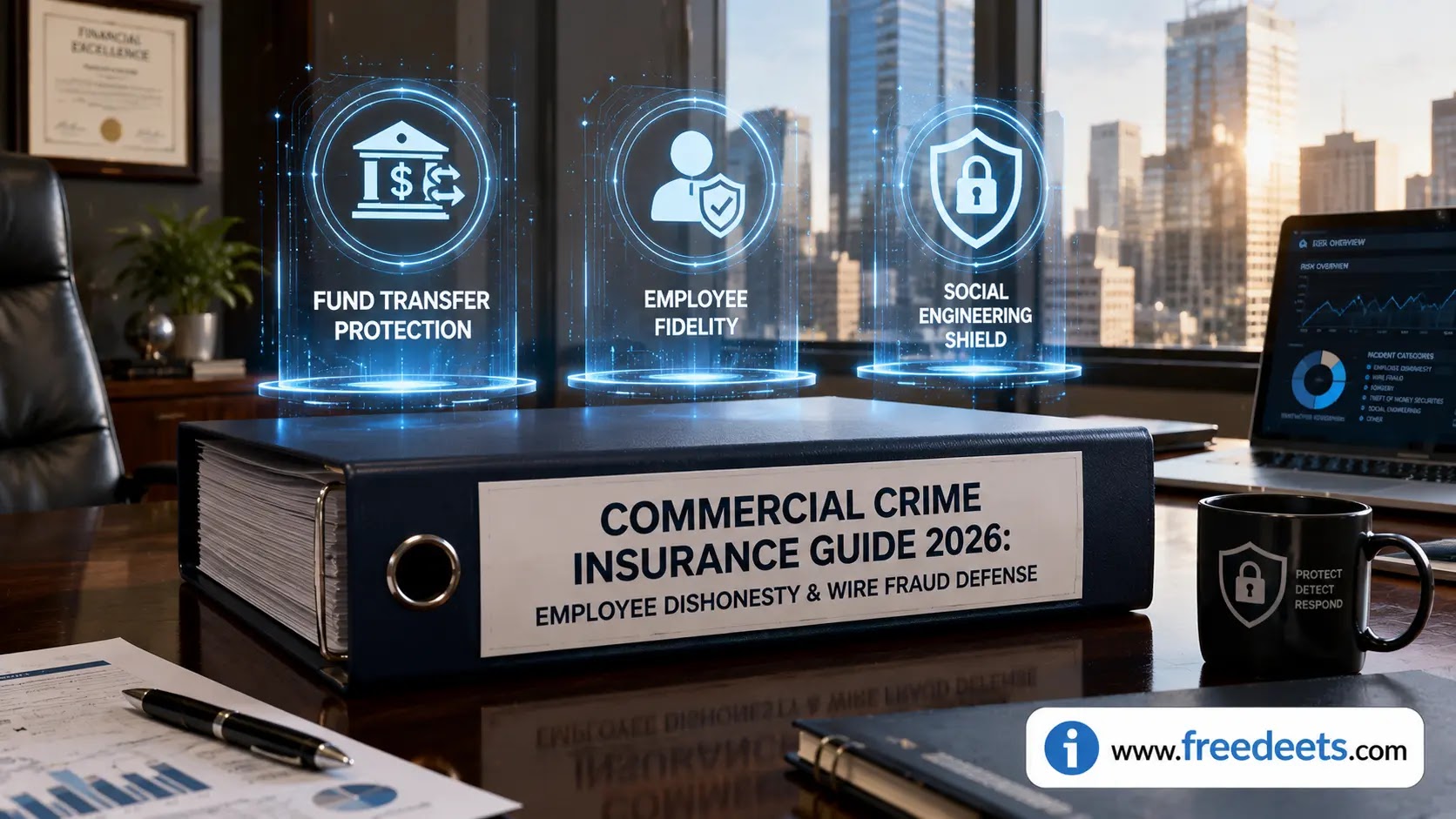
A common misconception among business owners is that general liability or property insurance covers internal theft. Standard commercial packages explicitly exclude losses stemming from employee dishonesty, forged financial instruments, and unauthorized account withdrawals. According to fraud benchmarking research from the Association of Certified Fraud Examiners (ACFE), organizations lose an estimated 5% of gross annual revenue to occupational fraud, making specialized crime policies essential for capital preservation.
Executive Summary: The Internal Fraud Gap
Standard commercial general liability and cyber policies do not reimburse stolen operating funds caused by internal theft or social engineering trickery. Businesses require dedicated commercial crime insurance with tailored insuring agreements to protect liquidity.
1. Core Insuring Agreements in Commercial Crime Insurance
Commercial crime insurance policies (often referred to as corporate fidelity policies) are constructed using modular insuring agreements. Companies can tailor these modules to fit their transaction volumes, inventory models, and banking protocols:
- Employee Theft and Dishonesty: Reimburses direct financial losses of cash, securities, or physical inventory caused by fraudulent acts committed by employees, acting independently or in collusion with outsiders.
- Forgery or Alteration: Protects against financial losses when bad actors forge, alter, or falsify outgoing business checks, drafts, promissory notes, or financial exchange instruments.
- Inside the Premises Loss: Shields money and securities located on corporate premises or inside banking repositories against physical disappearance, robbery, destruction, or safe burglary.
- Outside the Premises Transit: Covers business money and securities while being transported by an armored motor vehicle or an authorized corporate messenger.
- Computer and Funds Transfer Fraud: Protects against fraudulent electronic instructions or altered system data that causes financial institutions to transfer company funds into unauthorized accounts.
2. Social Engineering Fraud and Business Email Compromise
One of the fastest-growing commercial loss categories involves social engineering fraud, commonly referred to as executive impersonation or CEO fraud. In these schemes, criminals do not breach bank accounts through technical malware; instead, they manipulate accounting employees into voluntarily transferring money.
According to annual threat reports compiled by the FBI Internet Crime Complaint Center (IC3), business email compromise generates billions in exposed losses annually. For instance, a criminal may spoof a corporate vendor’s email address and request updated wiring instructions just before an invoice payment is scheduled.

A cyber liability policy covers data recovery, extortion negotiations, and forensic investigation after a network hack. However, direct losses of liquid cash caused by fraudulent transfer instructions require a dedicated Social Engineering Fraud Endorsement under your commercial crime policy.
3. Commercial Crime Insurance vs. Commercial Fidelity Bonds
While business owners sometimes use the terms interchangeably, commercial crime policies and third-party fidelity bonds protect entirely different parties:
| Feature Metric | Commercial Crime Insurance | Commercial Fidelity Bonds (Third-Party) |
|---|---|---|
| Protected Entity | Your own business assets and operating bank accounts | Your client’s property from dishonest acts by your staff |
| Triggering Event | Internal embezzlement, wire fraud, check alteration | Employee theft while working on-site at a customer location |
| Target Industry | All small, mid-size, and enterprise companies | Janitorial firms, IT contractors, security guards |
| Repayment Duty | The insurer absorbs the verified loss above deductible | The surety pays your customer, then seeks recovery from you |
4. Key Policy Exclusions and Required Accounting Safeguards
Carriers underwrite crime coverage based on your organization’s internal controls. Failing to enforce documented accounting procedures can lead to claim denials during loss reviews.
Common Exclusions
- Partner or Executive Dishonesty: Theft carried out by primary equity partners, LLC members, or corporate directors is excluded from basic forms (requiring specialized executive coverage).
- Inventory Calculation Losses: Shortages where the only proof of theft is a spreadsheet discrepancy, without independent evidence of employee misconduct.
- Prior Knowledge of Bad Actors: Theft committed by an employee after management was already aware of earlier dishonest acts by that individual.
Essential Accounting Safeguards
- Dual-Authorization Protocols: Enforce a strict policy requiring two independent manager approvals for any outward wire transfer exceeding set limits (e.g., $10,000).
- Out-of-Band Callback Verification: Require financial staff to verify vendor bank detail changes via a previously confirmed phone number before releasing payments.
- Mandatory Consecutive Leave: Require accounting employees to take consecutive days of annual leave, allowing alternative staff to review account ledgers.
Frequently Asked Questions About Commercial Crime Insurance
How much does commercial crime insurance cost per year?
For small to mid-sized businesses seeking $1 million in coverage limits, annual premiums typically range between $1,200 and $3,500. Rates depend on gross annual revenue, cash handling volumes, historical loss records, and the strength of internal accounting safeguards.
Does property insurance cover cash stolen during an office burglary?
No. Standard commercial property policies explicitly exclude money and securities. Covering stolen cash requires an Inside the Premises / Loss of Money & Securities agreement under a commercial crime policy.
What does a “Discovery Form” mean in crime policies?
Most commercial crime policies use a Discovery Form trigger. This means the policy covers losses discovered during the active policy term, regardless of when the fraudulent scheme began, as long as it started after the policy’s retroactive date.
Core Takeaways for Corporate Officers
- Add a Social Engineering endorsement to protect against business email compromise.
- Enforce dual authorization on all outward electronic funds transfers.
- Select Discovery Form policies to protect against long-running embezzlement schemes.
Conclusion
Internal financial fraud represents a silent threat that can disrupt business cash flow and undermine years of profitable growth. Standard business packages leave significant balance sheet exposure by excluding theft of money and securities. Structuring comprehensive commercial crime insurance with social engineering coverage and disciplined accounting controls ensures your liquid capital remains protected against modern workplace fraud.