Tony Bennett Legacy: Career, Fine Art, Estate & Alzheimer’s Journey
Few figures in American cultural history command the universal reverence, cross-generational admiration, and artistic longevity associated with the Tony Bennett legacy. Spanning eight remarkable decades, Anthony Dominick Benedetto (August 3, 1926 – July 21, 2023) did far more than perform popular jazz; he served as the premier custodian of the Great American Songbook. This comprehensive guide explores his legendary musical career, his parallel achievements in fine art under his birth name, the ongoing management of his intellectual property estate, and his groundbreaking Alzheimer’s journey.

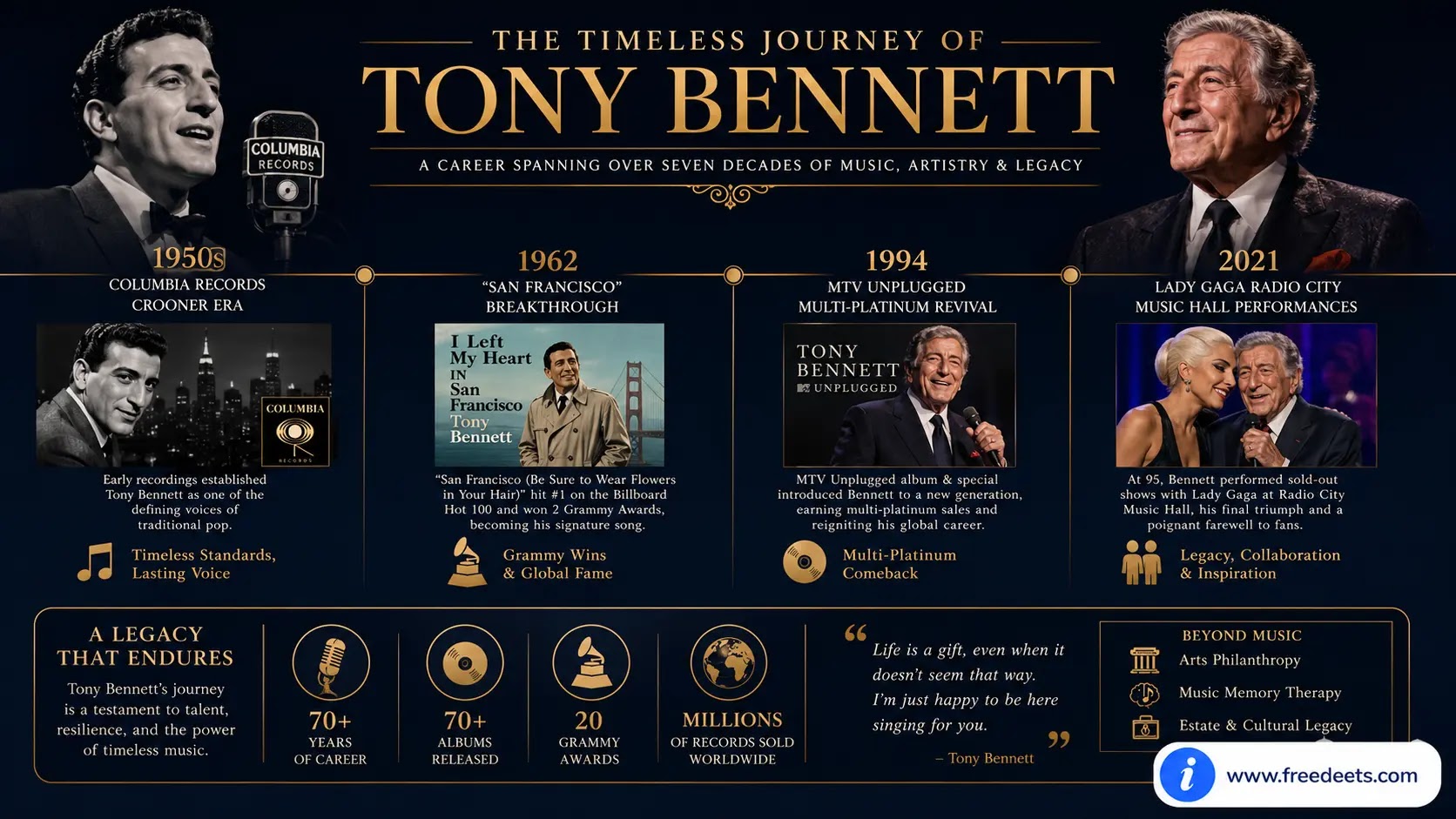
From his early breakthroughs as a mid-century Columbia Records crooner to his multi-platinum duets with modern pop icons like Lady Gaga, Bennett’s artistic trajectory stands unmatched in recorded entertainment. According to official historical records documented by the Recording Academy (Grammy Awards), Bennett earned 20 Grammy Awards and sold more than 50 million albums worldwide. Beyond recording milestones, his cultural footprint encompasses museum-collected oil paintings, dedicated public arts philanthropy, and significant clinical insights into music therapy for dementia patients.
Core Legacy Insight
Tony Bennett’s impact extends far beyond music. Painting under his birth name, Anthony Benedetto, his fine art is permanently accessioned into the Smithsonian Institution, while his final public concerts advanced global clinical research into neurological music preservation.
1. Early Life, WWII Combat, and Classical Vocal Foundations
Anthony Dominick Benedetto was raised in Astoria, Queens, New York, during the Great Depression. Growing up in a working-class Italian-American home, he immersed himself in the phrasing of big band swing, American jazz standards, and classic Italian bel canto vocal techniques.
His artistic development was interrupted when he was drafted into the United States Army during World War II. Serving in the 63rd Infantry Division, he fought on the front lines of the Battle of the Bulge in Western Europe and took part in the liberation of a sub-camp of Dachau near Landsberg, Germany. These harrowing experiences turned him into a lifelong pacifist and vocal supporter of civil rights.
Returning to New York under the G.I. Bill, he studied the Bel Canto technique at the American Theatre Wing under Miriam Spier. This classical training taught him breath support, resonant phrasing, and diaphragmatic control—the exact physical disciplines that protected his vocal cords and allowed him to maintain a powerful, resonant tone into his mid-90s.
In 1949, entertainer Bob Hope heard him perform in Greenwich Village alongside Pearl Bailey and invited him to join his national tour, suggesting he shorten his professional stage name to Tony Bennett. Soon after, legendary Columbia Records producer Mitch Miller signed him to the label.
2. The Great American Songbook and “San Francisco”
Throughout the 1950s, Bennett achieved steady chart success with hits like “Because of You,” “Cold, Cold Heart,” and “Rags to Riches.” As rock and roll transformed commercial radio in the late 1950s, Bennett deliberately gravitated toward sophisticated jazz arrangements, recording landmark collaborative albums with Count Basie, Duke Ellington, and Stan Getz.
The Breakthrough of “I Left My Heart in San Francisco”
In late 1961, Bennett recorded a ballad penned by George Cory and Douglass Cross: “I Left My Heart in San Francisco.” Released in early 1962, the song became an international standard, staying on the Billboard charts for nearly three years. The track earned Bennett his first two Grammy Awards and created an enduring global anthem that defined his live concert performances for the next sixty years.
3. The 1990s Career Renaissance and MTV Unplugged
During the 1970s, changing musical trends, tax burdens, and corporate disputes over material selection presented serious professional challenges. The turning point arrived when Bennett appointed his son, Danny Bennett, as his personal and business manager in 1979.
| Career Era | Strategic Focus | Core Channels | Commercial Impact |
|---|---|---|---|
| 1950s – 1960s | Columbia Records Pop & Big Band | Vinyl LPs, AM Radio, Supper Clubs | Multi-million sales; initial Grammy wins |
| 1970s | Independent Jazz Projects (Improv Records) | Intimate Jazz Clubs, European Tours | Critical acclaim alongside distribution hurdles |
| 1980s – 1990s | Danny Bennett Modern Management | College Campus Shows, MTV Unplugged, Late Night TV | Double-Platinum comeback; Album of the Year |
| 2010s – 2020s | Collaborative Duets (Lady Gaga) | Global Stadiums, Streaming Platforms, Documentaries | Guinness World Records; Billboard #1 Albums |
Rather than asking Bennett to adopt modern pop trends, management introduced his authentic style directly to younger audiences. He made guest appearances on college radio, late-night television shows, and animated programs like The Simpsons. This effort culminated in his 1994 MTV Unplugged performance, which went double-platinum and captured the Grammy Award for Album of the Year in 1995, introducing standard jazz literature to a generation of younger fans.
4. Fine Art: The Paintings of Anthony Benedetto
While globally acclaimed for his vocal talent, Bennett maintained a dedicated parallel career as a serious painter under his birth name, Anthony Benedetto. Painting daily in watercolor, oil, and charcoal, he exhibited works in galleries worldwide.
His artwork has received widespread institutional recognition. Three of his original oil paintings are permanently preserved in the archives of the Smithsonian Institution in Washington, D.C., including his portrait of Ella Fitzgerald at the National Portrait Gallery. His paintings of Central Park and European landscapes frequently command five-figure valuations at fine art auctions.
Philanthropic Contributions to Arts Education
In 1999, Bennett and his wife, Susan Benedetto, founded Exploring the Arts (ETA), a nonprofit dedicated to supporting arts instruction in urban public high schools. They established the Frank Sinatra School of the Arts, an acclaimed public magnet high school in his hometown of Astoria, Queens. Today, ETA supports arts curriculum programming across dozens of public high schools in New York City and Los Angeles.
5. Clinical Neurology and the Alzheimer’s Journey
In 2016, Bennett was diagnosed with Alzheimer’s disease. Supported by his family and medical team at New York’s Mount Sinai Hospital, he continued actively rehearsing, recording, and performing through late 2021.
His medical journey became an important case study in clinical neurology, illustrating neurological music preservation:
- Preserved Neural Pathways: While Alzheimer’s affected his short-term memory and conversational speech, his musical memory—anchored in deep auditory and motor memory circuits—remained completely intact.
- Lady Gaga Studio Collaborations: Bennett recorded two collaborative jazz albums with Lady Gaga: Cheek to Cheek (2014) and Love for Sale (2021). The latter release earned him a Guinness World Record as the oldest artist to release a new studio album (at age 95).
- The Radio City Farewell Concerts: In August 2021, Bennett performed two sold-out concerts at Radio City Music Hall titled One Last Time. Despite moments of disorientation backstage, the second he walked into the spotlight, he delivered a 90-minute live set from memory without lyric prompters.
6. Estate Valuation and Intellectual Property Assets
Following his peaceful passing in New York on July 21, 2023, at the age of 96, analysts highlighted the durable structure of his intellectual property holdings:
- Catalog Master Royalties: Ongoing royalty shares across physical albums, downloads, and streaming platforms managed under long-term Sony Music licensing agreements.
- Name, Image, and Likeness (NIL): Licensing agreements for film, television sync, and documentary projects managed through family trusts.
- Fine Art Holdings: A vast personal archive of original Benedetto paintings and sketches managed through selective museum loans and charitable trusts.
Frequently Asked Questions About the Tony Bennett Legacy
How many Grammy Awards did Tony Bennett win?
Tony Bennett won a total of 20 Grammy Awards, including 19 competitive wins and the Grammy Lifetime Achievement Award in 2001. His wins spanned nearly six decades, from 1963 to 2022.
Did Tony Bennett write his own songs?
Bennett was an interpreter rather than a composer. He dedicated his recording career to popularizing the Great American Songbook, performing classic compositions written by George Gershwin, Cole Porter, Irving Berlin, and Duke Ellington.
Where can the public view Tony Bennett’s paintings?
Three of his original paintings are housed in the permanent collection of the Smithsonian Institution in Washington, D.C., including his portrait of Ella Fitzgerald at the National Portrait Gallery.
How was Tony Bennett able to perform live with Alzheimer’s disease?
Neuroscientists explain that musical memory engages distinct, deeply embedded neural pathways that often remain functioning even when regions controlling short-term declarative memory undergo neurodegeneration.
Core Takeaways of the Tony Bennett Legacy
- Championed the Great American Songbook across eight distinct decades.
- Maintained an accomplished parallel fine art career as Anthony Benedetto.
- Advanced clinical understanding of music therapy in Alzheimer’s care.
Conclusion
The Tony Bennett legacy represents a timeless testament to artistic integrity, continuous reinvention, and human resilience. By remaining dedicated to the finest American compositions, creating celebrated visual art, and demonstrating the healing power of music during his final years, Bennett left an indelible mark on cultural history that continues to inspire audiences worldwide.