Unveiling the Untold Story of Steve Smith: From Underdog to Cricket Legend
Exploring the remarkable journey of Steve Smith, cricket legend and modern batting master, reveals one of the most dramatic transformations in the history of international sports in 2026. In an era dominated by textbook coaching doctrines and rigid biomechanics, Steven Peter Devereux Smith redefined batting through sheer hand-eye coordination, psychological resilience, and relentless determination. From entering the Australian national team as an unproven leg-spinning all-rounder to becoming the consensus greatest Test batsman since Sir Donald Bradman, Smith’s career embodies sporting perseverance.
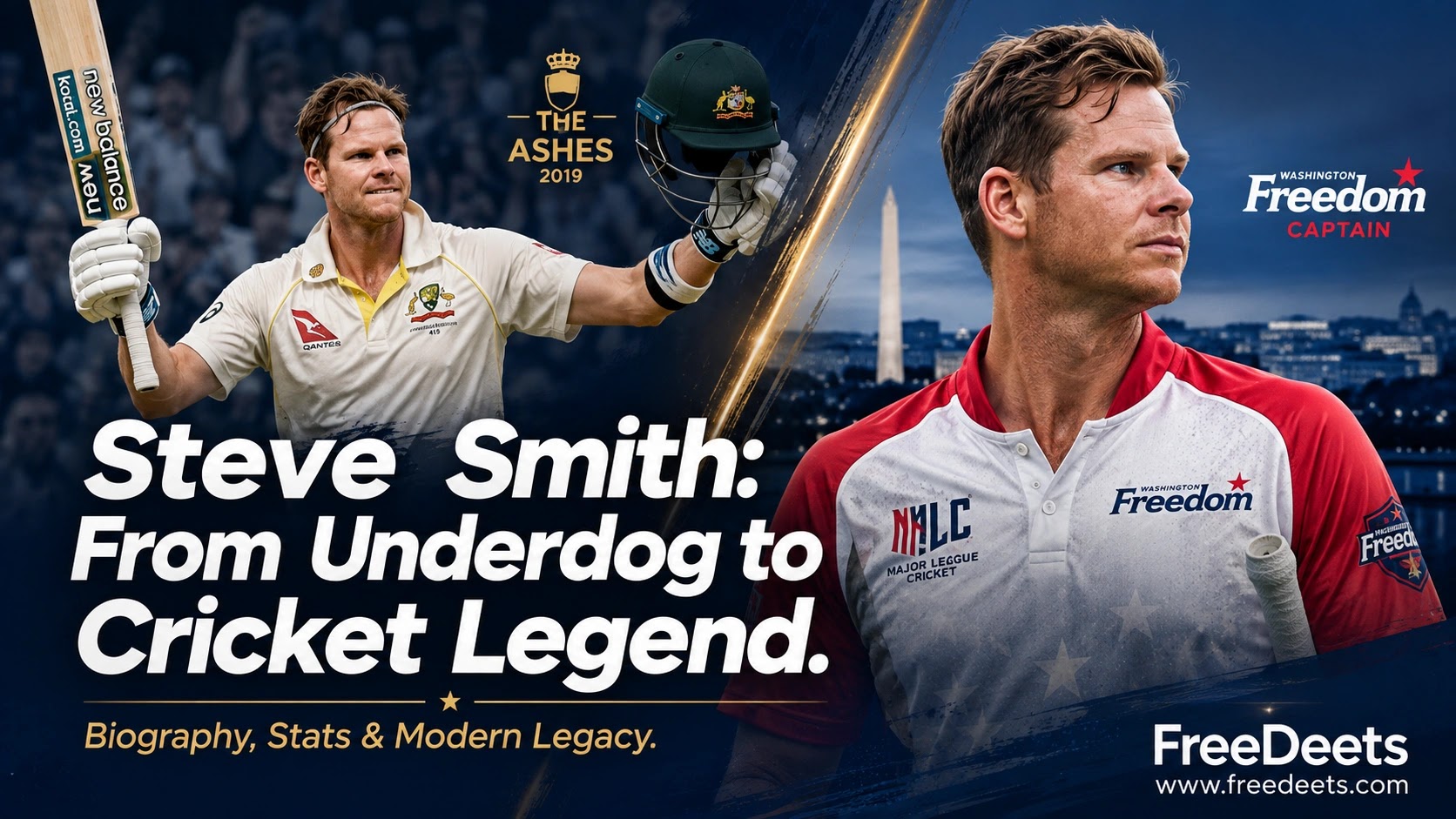
Few cricket analysts anticipated Smith’s ascent when he made his international debut against Pakistan at Lord’s in 2010. Pundits questioned his fidgety mannerisms at the crease, unusual trigger shuffle across the stumps, and unorthodox stroke selection. However, according to official player archives maintained by the International Cricket Council (ICC), Smith reached an extraordinary Test batting rating of 947 in late 2017—the second-highest rating achieved by any batsman in the 147-year history of Test match cricket, trailing only Bradman’s 961.
Core Athletic Distinction
Steve Smith is one of only two cricketers in history to score four consecutive centuries in a single Test series against India, achieving 769 runs at an average of 128.16 during the 2014–15 Border-Gavaskar Trophy series.
1. Early Life and Suburban Sydney Beginnings
Born on June 2, 1989, in Kogarah, a southern suburb of Sydney, New South Wales, Smith’s childhood was dedicated entirely to athletic mastery. Supported by his father, Peter, and English-born mother, Gillian, young Smith spent endless hours hitting tennis balls and taped cricket balls on narrow concrete driveways to develop rapid hand-eye reflex timing.
Smith’s dual British-Australian heritage enabled him to spend formative teenage summers competing in English club cricket for Sevenoaks Vine in the Kent Cricket League. These competitive overseas stints taught him how to handle swinging seam deliveries on damp, seaming turf wickets. When he broke into the New South Wales state squad in 2008, he was initially selected as an aggressive lower-order batsman and leg-spin bowler, viewed by selectors as a long-term prospect to fill the void left by Shane Warne’s retirement.
2. Technical Transformation: Decoding the Shuffle Across the Stumps
Dropped from the Australian squad in 2011 due to inconsistent bowling and erratic shot selection, Smith made a bold career decision: he stopped bowling leg-spin and dedicated his training entirely to mastering top-order batting. During the 2013 Ashes tour in England, he debuted his revolutionary pre-delivery trigger movement:
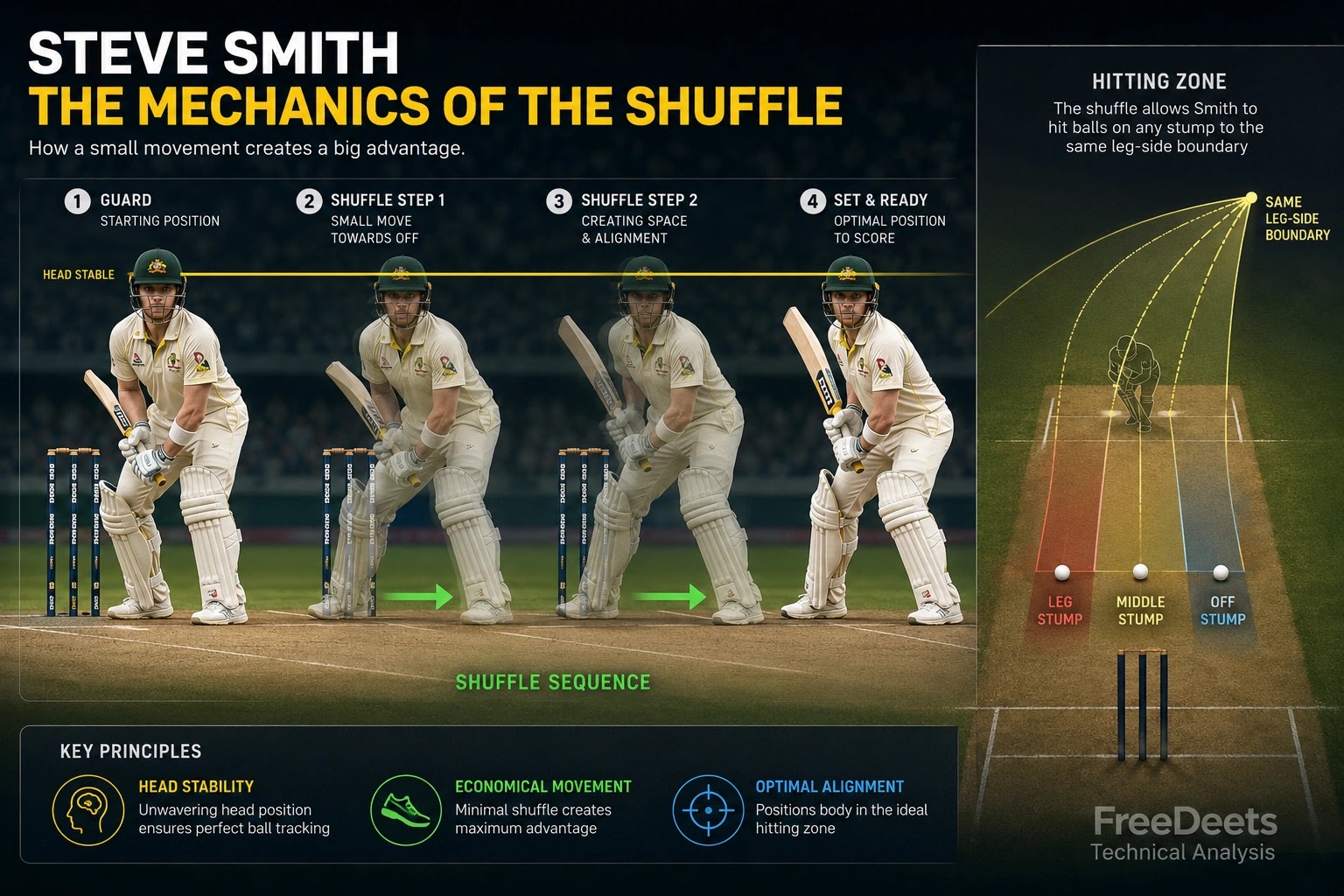
- Eliminating the LBW Threat: By shuffling his back foot across toward off-stump as the bowler enters delivery stride, Smith covers his stumps completely. Any delivery targeting his pads can be wrist-flicked to the leg-side boundary with zero danger of an LBW dismissal.
- Precise Judgment of Off-Stump: Because his eyes line up directly over the off-stump channel, he leaves incoming outswingers with extreme spatial awareness, forcing pace bowlers to expend physical energy bowling unproductive wider lines.
- Still Head at Point of Impact: Despite constant fidgeting, toe-tapping, and bat adjustments prior to the bowler’s run-up, Smith’s head remains motionless the split-second the ball is released, ensuring pristine visual tracking.
3. The Golden Era: Ascending to World Number One (2014–2017)
Following his maiden Test century at the historic Perth WACA ground in late 2013, Smith embarked on one of the most dominant statistical scoring runs in modern sports history:
| Test Calendar Year | Innings Batted | Total Runs Scored | Annual Batting Average | Centuries Scored |
|---|---|---|---|---|
| 2014 | 17 | 1,146 | 81.85 | 5 |
| 2015 | 24 | 1,474 | 73.70 | 6 |
| 2016 | 18 | 1,079 | 71.93 | 4 |
| 2017 | 20 | 1,305 | 76.76 | 6 |
In 2015, Smith was awarded the prestigious Sir Garfield Sobers Trophy for ICC Cricketer of the Year. Elevated to the Australian Test captaincy following Michael Clarke’s retirement, Smith responded with immense scoring outputs in challenging conditions—most notably during the 2017 tour of India, where he registered three centuries on treacherous spin surfaces in Pune, Ranchi, and Dharamshala.
4. The Fall: Sandpapergate and the 12-Month Suspension
Smith’s rapid rise met a sudden halt in March 2018 during Australia’s third Test against South Africa at Newlands in Cape Town. Broadcast cameras caught teammate Cameron Bancroft using yellow adhesive tape coated with sandpaper granules to alter the condition of the match ball.
In the post-match press conference, Smith confessed that the team’s leadership group was aware of the tactic. The regulatory response was swift and uncompromising. Cricket Australia issued unprecedented penalties, suspending Smith from all international and domestic Australian cricket for 12 months and banning him from national leadership roles for two years. Over the ensuing year, Smith engaged in community mentoring, worked quietly in suburban training nets, and accepted full accountability for his failure in captaincy oversight.
5. The 2019 Ashes Masterclass: The Ultimate Sporting Redemption
Returning to international cricket in August 2019 for the Ashes in England, Smith faced intense hostility and boos from opposing spectators. He answered with one of the most resilient batting displays in Test cricket history:
- First Test (Edgbaston): Walking in with Australia reeling at 122/8, Smith scored a magnificent 144, followed by 142 in the second innings to lead Australia to an improbable 251-run victory.
- Overcoming Physical Adversity at Lord’s: After being struck on the neck by a 92 mph bouncer from Jofra Archer in the second Test, Smith returned in the fourth Test at Old Trafford to score a double-century (211).
- A Historic Series Tally: Smith finished the five-match series with 774 runs in just seven innings at an astonishing average of 110.57, earning standing ovations from the English crowds and retaining the urn on away soil.
6. Expanding Cricket’s Global Reach: Washington Freedom and Major League Cricket
While his international pedigree was built in Melbourne, Sydney, and London, Smith’s influence has expanded directly into North America. With cricket confirmed for the 2028 Los Angeles Olympics, Major League Cricket (MLC) represents the sport’s newest frontier.
Leading the Washington Freedom franchise as captain alongside head coach Ricky Ponting, Smith has helped establish elite professional cricket standards within the United States. His high-profile presence in the American league has drawn international television audiences and inspired thousands of youth players emerging through US cricket academies.
7. Career Records and Individual Accolades
According to historical records compiled by ESPNcricinfo, Steve Smith’s statistical milestones place him among the sport’s all-time greats:
- ICC Men’s Test Player of the Decade (2011–2020): Awarded for superior run production and consistency over a ten-year span.
- Dual World Cup Champion: Crucial member of Australia’s victorious ICC Cricket World Cup campaigns in 2015 and 2023, and the 2021 T20 World Cup team.
- Fastest to Multiple Century Milestones: Among the quickest batsmen in history to reach 30 Test centuries, maintaining an overall Test batting average above 55.00 across more than a decade of international competition.
Frequently Asked Questions About Steve Smith
Is Steve Smith related to Sir Donald Bradman?
No, Steve Smith has no familial relation to Sir Donald Bradman. Pundits and historians frequently compare the two due to Smith’s remarkably high career Test average and his ability to score centuries in consecutive Test matches.
What makes Steve Smith’s batting stance so unique?
Smith utilizes an exaggerated back-and-across shuffle toward off-stump as the bowler runs in. This unconventional positioning helps him cover his stumps, leave deliveries outside off-stump with precision, and whip balls aimed at his body effortlessly to the leg side.
Does Steve Smith hold the record for the highest ICC Test batting rating?
Sir Donald Bradman holds the highest historic ICC Test batting rating at 961 points. Steve Smith holds the second-highest rating of all time at 947 points, which he achieved in December 2017.
Core Takeaways from Steve Smith’s Career
- Adaptability and disciplined technical reinvention can overcome early career setbacks.
- Unorthodox mechanics can succeed at the highest level when paired with hand-eye coordination.
- True sporting legacy is determined by how athletes respond to and recover from adversity.
Conclusion
The story of Steven Peter Devereux Smith is far more than a chronicle of centuries and trophies. It is a story of athletic reinvention, profound accountability, and historic sporting redemption. From an overlooked leg-spinner fighting for a permanent spot in the national setup to the world’s premier Test batsman, Smith’s journey illustrates what is possible when work ethic meets unwavering self-belief. As he continues competing on international stages and leading franchises in Major League Cricket, Steve Smith has permanently etched his name into the annals of global sporting greatness.