Inside the James Webb Space Telescope: Discoveries Shaping Modern Astrophysics
Exploring the groundbreaking observations of the James Webb Space Telescope (JWST) reveals how NASA’s premier space observatory is fundamentally transforming modern astrophysics in 2026. For centuries, optical astronomy was constrained by thick interstellar dust clouds and the physical limits of ground-based and low-Earth-orbit instruments. By peering into deep space using advanced infrared instruments, the James Webb Space Telescope captures ancient light emitted over 13.5 billion years ago, analyzing the universe’s earliest stellar nurseries and characterizing distant exoplanetary atmospheres with unprecedented precision.
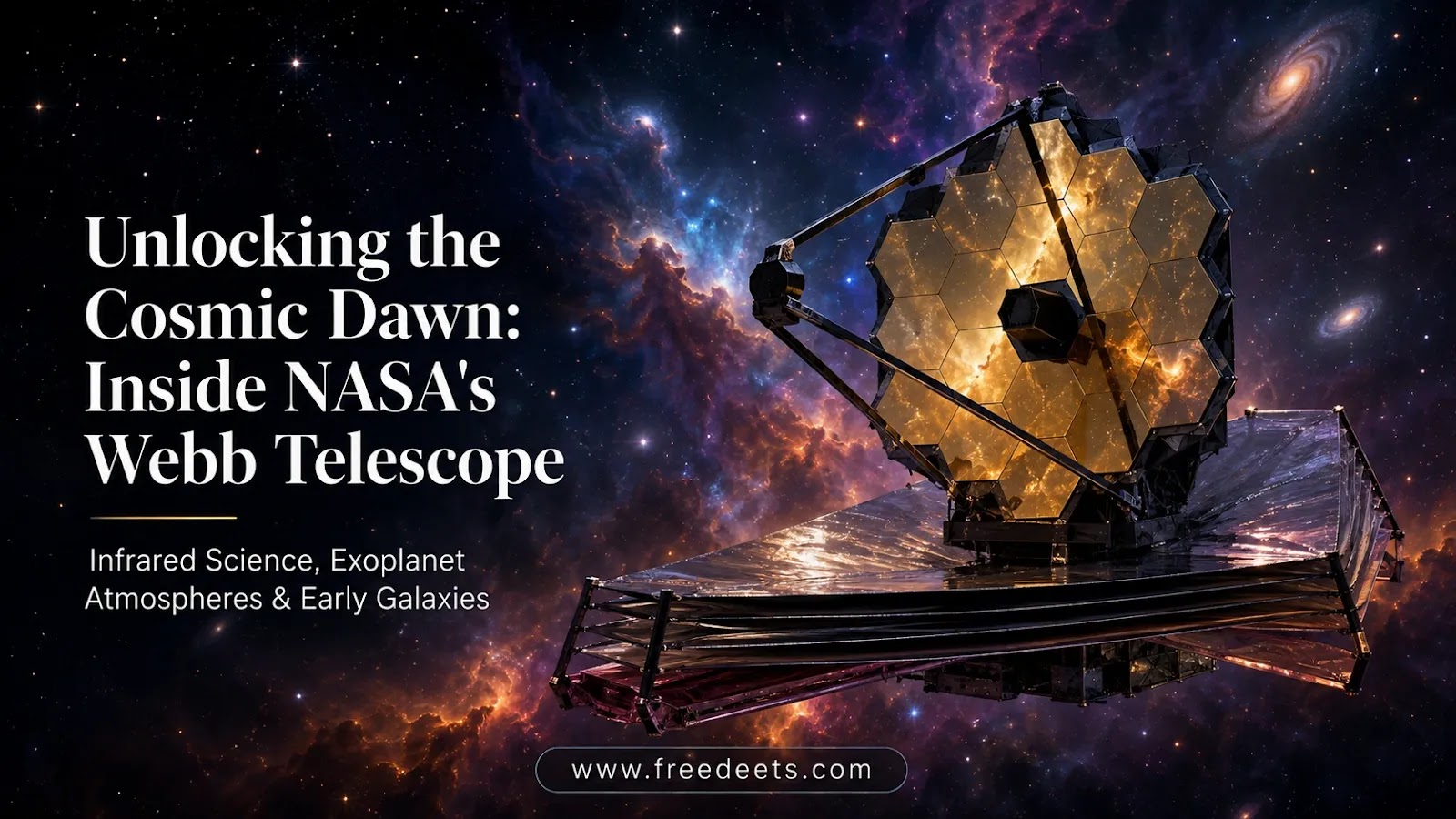
Developed through a historic international partnership between NASA, the European Space Agency (ESA), and the Canadian Space Agency (CSA), Webb represents the most ambitious engineering feat in observational cosmology. According to technical flight data published by the NASA Goddard Space Flight Center, JWST’s primary mission spans four core astronomical disciplines: capturing the first stars of the cosmic dawn, studying the assembly of early galaxies, watching the birth of stars inside protoplanetary disks, and analyzing foreign planetary systems for chemical biosignatures.
Core Cosmological Principle: Cosmological Redshift
Because our universe has been continuously expanding since the Big Bang, light emitted by the earliest stars and galaxies has stretched across billions of light-years from ultraviolet and visible wavelengths into the infrared spectrum. Webb’s specialized infrared sensors detect these faint, highly redshifted wavelengths that remain invisible to optical telescopes.
1. How the James Webb Space Telescope Differs from Legacy Observatories
While the legendary Hubble Space Telescope transformed public and scientific understanding of the cosmos throughout the late 20th century, JWST was purposefully engineered to surpass Hubble’s physical and optical limitations:
- Infrared Optical Focus: While Hubble observes primarily in ultraviolet and visible light, Webb observes across near-infrared (NIR) and mid-infrared (MIR) wavelengths (0.6 to 28 microns). Infrared radiation pierces dense, cold interstellar dust clouds, allowing scientists to see inside stellar incubators.
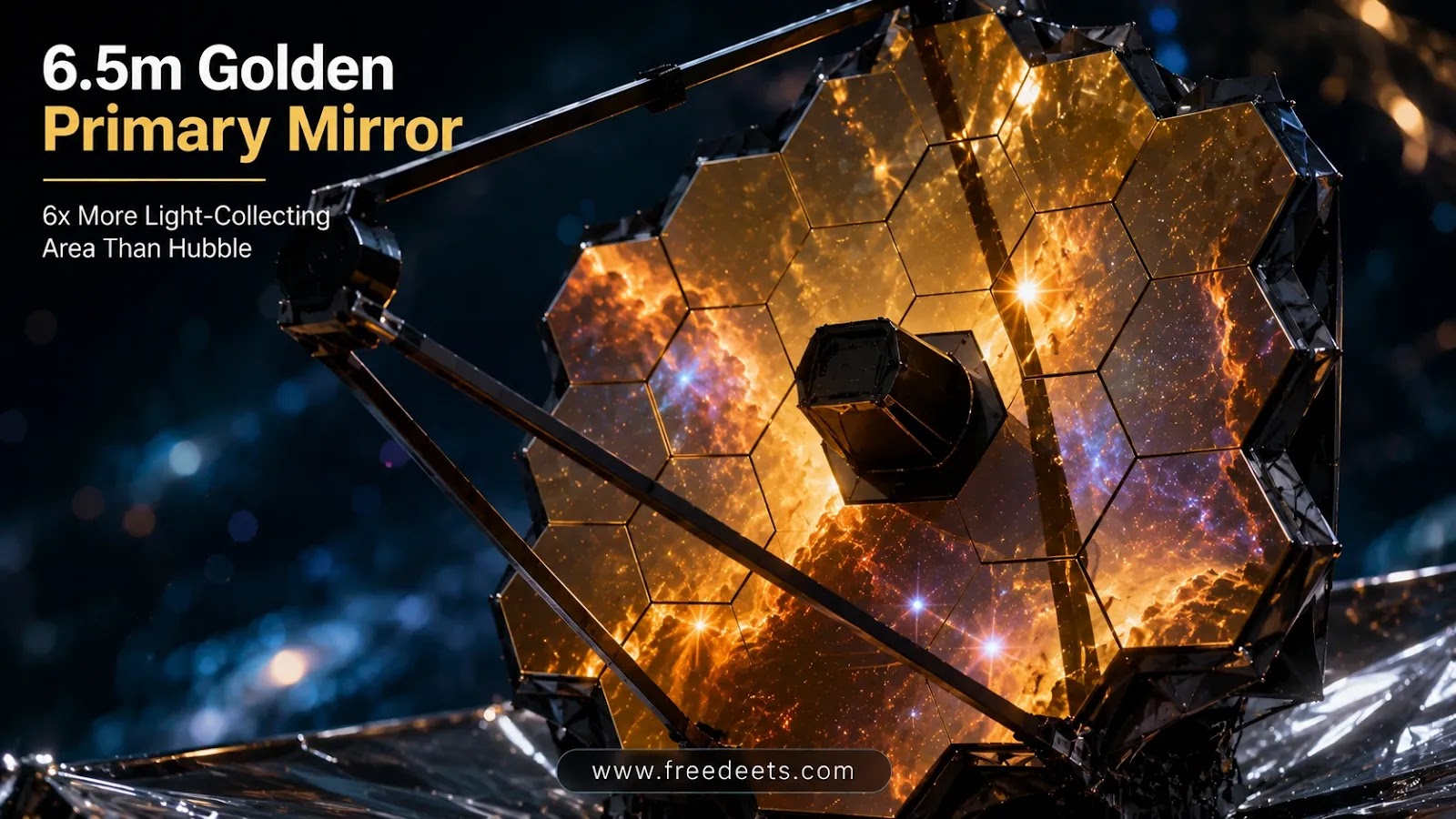
- Unprecedented Primary Mirror Aperture: Webb features an innovative 6.5-meter (21.3-foot) segmented aperture composed of 18 hexagonal beryllium mirrors coated in micro-thin vaporized gold. This provides over six times the light-gathering area of Hubble’s 2.4-meter monolithic mirror.
- Deep-Space Orbital Placement at Sun-Earth L2: Rather than orbiting Earth like Hubble, JWST orbits the Sun at the second Lagrange point (L2), approximately one million miles (1.5 million kilometers) from Earth. This location keeps the spacecraft in thermal equilibrium while protecting its detectors from Earth’s atmospheric glow and thermal radiation.
2. Technical Architecture: Hubble vs. James Webb Space Telescope
Comparing the engineering and technical metrics of both observatories highlights why Webb delivers unprecedented resolution and analytical depth:
| Engineering Dimension | Hubble Space Telescope | James Webb Space Telescope (JWST) |
|---|---|---|
| Primary Mirror Diameter | 2.4 meters (7.8 feet) | 6.5 meters (21.3 feet segmented) |
| Wavelength Coverage | Ultraviolet & Visible (0.1 to 0.8 microns) | Near-Infrared & Mid-Infrared (0.6 to 28 microns) |
| Orbital Station | Low Earth Orbit (~340 miles altitude) | Sun-Earth L2 Lagrange Point (~930,000 miles) |
| Operating Temperature | Roughly 20°C (room temperature) | Below -233°C (-388°F); MIRI cryocooled to 7 Kelvin |
| Thermal Shielding | Standard spacecraft thermal blankets | Five-layer Kapton sunshield the size of a tennis court |
According to research guidelines published by the Space Telescope Science Institute (STScI), operating in deep cryogenic conditions prevents the telescope’s own mechanical warmth from blinding its ultra-sensitive infrared sensors, enabling the detection of photon streams emitted when the universe was less than 300 million years old.
3. 5 Major Discoveries Reshaping Modern Astrophysics
Since commencing official science operations, the James Webb Space Telescope has produced landmark discoveries that challenge established cosmological models:
- Uncovering the Earliest Galaxies (JADES-GS-z14-0): Webb has shattered previous cosmic distance records by observing fully formed, unexpectedly luminous galaxies dating back to just 290 million years after the Big Bang. These observations are compelling astrophysicists to revise theories regarding how rapidly supermassive black holes and early galaxies accreted matter.
- Atmospheric Spectroscopy of Exoplanets: By capturing the starlight filtering through the atmospheres of foreign gas giants and rocky super-Earths (such as WASP-96b and the TRAPPIST-1 system), Webb’s transmission spectrographs have mapped detailed chemical signatures of water vapor, carbon dioxide, sulfur dioxide, and methane clouds.
- Piercing Stellar Nurseries (The Pillars of Creation): Webb’s near-infrared cameras have penetrated the iconic Eagle Nebula’s dense columns of interstellar gas, revealing thousands of newly ignited protostars and analyzing how gravitational collapses produce solar systems.
- Direct Imaging of Circumstellar Protoplanetary Disks: Utilizing internal coronagraphs to block direct glare from parent stars, Webb captures high-contrast images of protoplanetary disks, providing direct evidence of planet-formation dynamics in real time.
- Unprecedented Views of Our Outer Solar System: Webb has returned extraordinary infrared views of Jupiter’s auroras, Neptune’s delicate dust rings, and Saturn’s moon Enceladus, tracking massive water vapor plumes erupting hundreds of miles into space.
4. The Scientific Instrument Suite Inside JWST
To execute its ambitious scientific mission, Webb houses four state-of-the-art instruments inside its Integrated Science Instrument Module (ISIM):
- Near-Infrared Camera (NIRCam): Provided by the University of Arizona, NIRCam serves as Webb’s primary imager in the 0.6 to 5 micron range, equipped with specialized coronagraphs to photograph faint exoplanets around bright stars.
- Near-Infrared Spectrograph (NIRSpec): Built by the European Space Agency, NIRSpec features a revolutionary microshutter array containing roughly 250,000 individually controlled micro-doors, allowing it to observe over 100 individual galaxies simultaneously in a single field of view.
- Mid-Infrared Instrument (MIRI): A joint development between NASA and a European consortium, MIRI provides wide-field imaging and spectroscopy across long infrared wavelengths (5 to 28 microns), cooled to an astonishing -266°C via a closed-cycle helium loop cryocooler.
- Fine Guidance Sensor / Near-Infrared Imager and Slitless Spectrograph (FGS/NIRISS): Provided by the Canadian Space Agency, the FGS enables millimeter-precision pointing stability, while NIRISS performs high-precision aperture masking interferometry.
5. The Future of Deep Space Astronomy in 2026 and Beyond
Due to the flawless precision of its Ariane 5 rocket launch in late 2021, JWST expended far less onboard propellant for orbital correction maneuvers than originally budgeted. NASA flight dynamics teams confirm that Webb retains sufficient hydrazine and nitrogen tetroxide station-keeping fuel to support continuous scientific operations well into the late 2030s.
As astrophysicists process petabytes of open-access observational datasets, Webb’s findings will lay the empirical groundwork for the next generation of space observatories, including NASA’s upcoming Nancy Grace Roman Space Telescope and the proposed Habitable Worlds Observatory. The observatory continues to provide an enduring testament to human curiosity and international scientific collaboration.
Frequently Asked Questions About the James Webb Space Telescope
How far can the James Webb Space Telescope see?
The James Webb Space Telescope does not measure observation strictly by physical distance, but by cosmic time. Because light travels at a finite speed, Webb’s high-sensitivity infrared instruments can observe galaxies whose light was emitted over 13.5 billion years ago, representing the earliest epochs following the Big Bang.
Can astronauts visit or repair JWST like they did with Hubble?
No. Hubble was stationed in low Earth orbit roughly 340 miles above the planet, allowing Space Shuttle crews to execute manual servicing missions. Webb is stationed nearly one million miles away at the second Lagrange point (L2), far beyond the reach of crewed spacecraft. Every solar array deployment, sunshield tensioning, and mirror segment alignment had to succeed autonomously.
Why are Webb’s mirrors coated in real gold?
Webb’s 18 beryllium mirror segments are vacuum-vaporized with a microscopically thin coating of pure gold (measuring approximately 100 nanometers in thickness). Gold provides the highest optical reflectivity across the near-infrared and mid-infrared spectrums, ensuring that over 98% of incoming infrared photons bounce directly into the scientific detectors.
Core Takeaways for Astronomy Enthusiasts
- Infrared instrumentation enables Webb to see through dense cosmic dust and observe redshifted light.
- Stationed at the Sun-Earth L2 Lagrange point, the observatory operates in deep cryogenic conditions.
- Ample onboard station-keeping propellant ensures continued deep-space science through the 2030s.
Conclusion
The James Webb Space Telescope stands as an extraordinary triumph of modern aerospace engineering and astrophysics. By shifting humanity’s observational view from visible light into deep infrared wavelengths, JWST is unlocking secrets of galaxy formation, probing the atmospheric chemistry of potentially habitable exoplanets, and challenging long-held cosmological paradigms. As ongoing observation cycles continue throughout 2026 and beyond, Webb will continue expanding our scientific understanding of the universe and our place within it.